
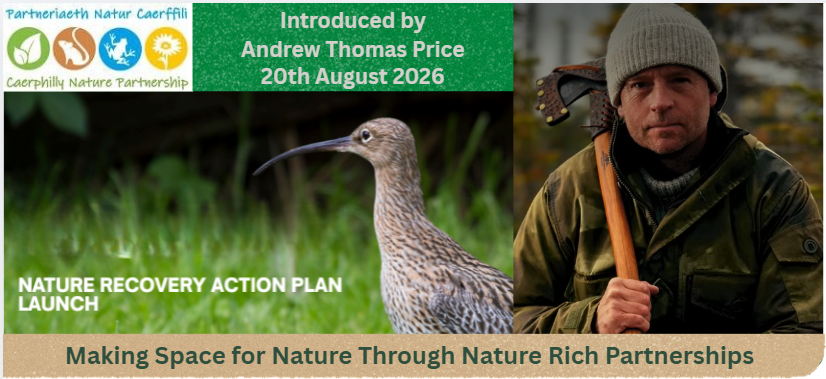
The Caerphilly Nature Recovery Action Plan Launch.
What a day!
We were delighted to be part of the launch of the Caerphilly Nature Recovery Action Plan (NRAP) at Bedwas Workmen’s Hall. A fantastic gathering of people, organisations, community groups and nature specialists all sharing one thing in common: a passion for protecting, restoring and celebrating the natural world on our doorstep.
And, of course, Caerphilly Woodlands Trust was there with our stand and, rather nervously, on the main stage too!
A partnership bringing nature together
The day began with an introduction from Christopher Hatch, Chair of the Caerphilly Nature Partnership, who explained the work of this growing collaborative network.
The Caerphilly Local Nature Partnership (LNP) brings together an impressive range of people and organisations committed to nature recovery and biodiversity enhancement across Caerphilly County Borough. That includes members of the public, community groups like ours, council representatives, landowners and businesses, public services and wildlife professionals, all sharing knowledge, ideas and a determination to make a difference.
The partnership now has more than 100 members, representing over 40 organisations, including Natural Resources Wales, Amphibian and Reptile Conservation, Buglife and Gwent Wildlife Trust.
For us, this is particularly exciting because Caerphilly Woodlands Trust already has connections across this wider nature-recovery family. We have links with the organisations involved in the county’s landscape and nature initiatives, contribute to the Resilient Ecological Networks (RENs) work, and play our part through the Local Places for Nature programme and its steering group.
It really does feel as though something important is happening across Caerphilly, people are connecting the dots.
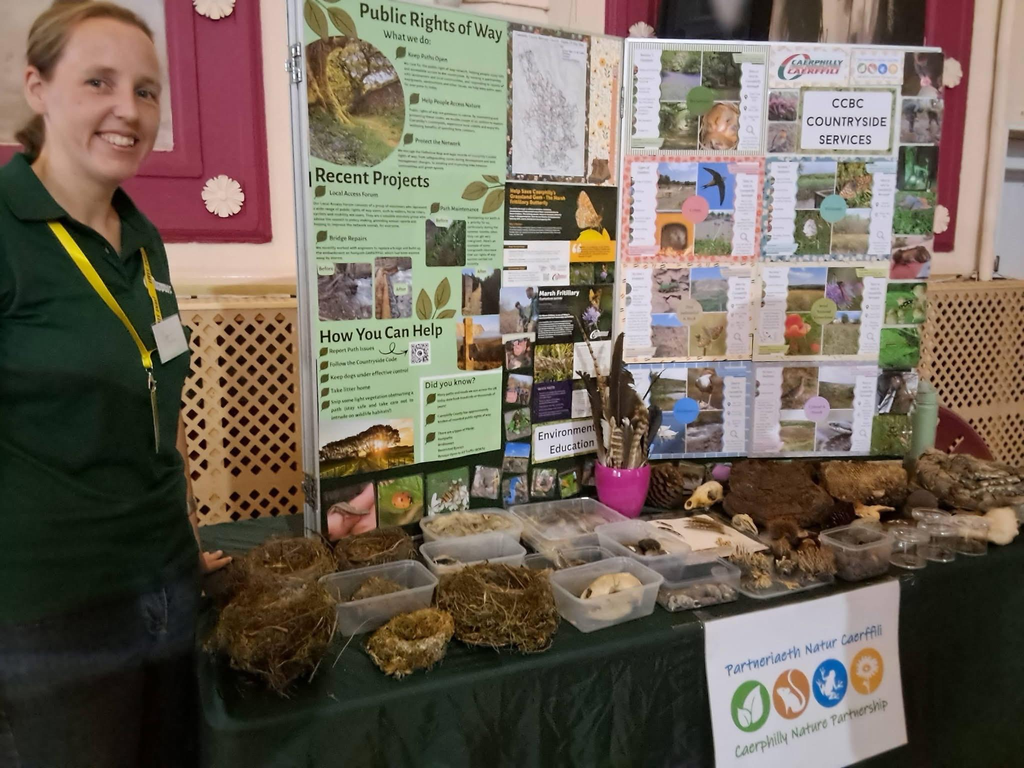
Catrin Moss CCBC Countryside Services
A day packed with nature knowledge
The launch brought together an amazing range of specialists, with a series of short, fascinating talks highlighting some of the species and habitats that make Caerphilly so special.
We heard from Mat Cooke of Amphibian and Reptile Conservation, Stephanie Tyler, who shared her knowledge of the Dipper, Dave Williams on hedgehogs, Kerry Rogers on Hazel Dormice, Liam Way on the Marsh Fritillary, Simon Maggs on Curlew, Andy Karran on Bluebells and Waxcaps, and Sarah Morgan on Swifts.
Each talk was a little window into a different part of our natural world and a reminder of just how much there is to discover, protect and restore right here in Caerphilly.
There were also two fascinating main-stage presentations.
The morning session, from David Slade of SEWBReC, explored understanding and improving the data we collect about our natural environment.
Then, in the afternoon, it was the turn of Wellbeing Hubs.
Nature and wellbeing — the connection is real
This was particularly special for us because Caerphilly Woodlands Trust was invited to share the story of our Wellbeing Hub.
Alongside us was another Caerphilly Wellbeing Hub which is in the early stages of setting up, showing the different ways that this idea is beginning to grow across the county.
Dez Jones from the CCBC/Gwent Green Grid team introduced Caerphilly Woodlands Trust and Ty Sign, highlighting the work these two hubs are doing and the amazing results that can come from connecting people with nature.
For us, that connection is at the heart of everything we do.
Our woodland isn’t simply somewhere people visit. It is somewhere people can breathe, explore, learn, recover, connect and belong..
We see it every time someone discovers something new beneath the trees, joins a volunteer session, comes along to a wellbeing activity, hears an owl, watches a bat, gets their hands dirty or simply sits quietly in the woodland for a while. Nature has a remarkable way of helping us reconnect with ourselves and with one another.
And then there was our stand!
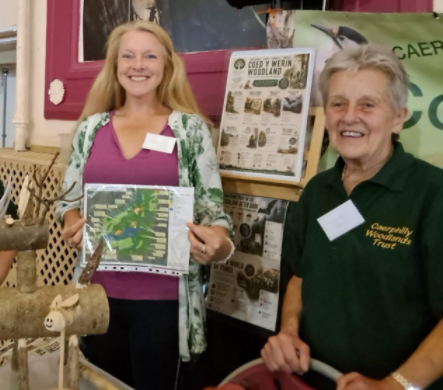
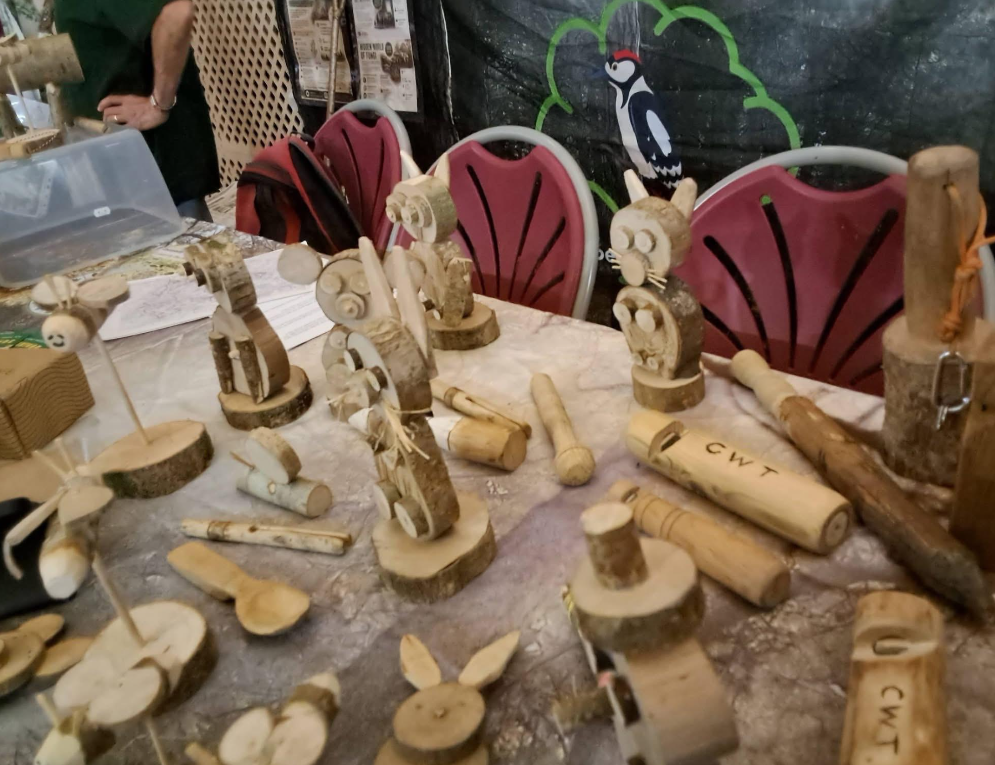
Martha & Cath with Dai and Lindsay in the background demonstrating the crafts made by visitors to our woodland
Our wonderful volunteers were kept busy throughout the day talking to visitors about Coed y Werin, our work and the many ways we connect people with nature.
One of the stars of the stand was our bio-sonification device, attached to a leafy green plant and demonstrating the hidden sounds of the natural world in a wonderfully different way.
There were woodland-made crafts to admire and take home, conversations about how we care for our site, and plenty of opportunities to explain what volunteering with Caerphilly Woodlands Trust is really about.
It was lovely to see people stopping, asking questions, sharing their own experiences and discovering that a community woodland can be so much more than trees, demonstrating that nature isn’t just a backdrop to our lives we are part of it connected to it.
Behind everything we do are our volunteers, people who give their time, enthusiasm, knowledge and care to help look after the woodland and, perhaps most importantly, to help other people experience the benefits of being connected to nature.
A very special MC, with a rather different relationship with nature!
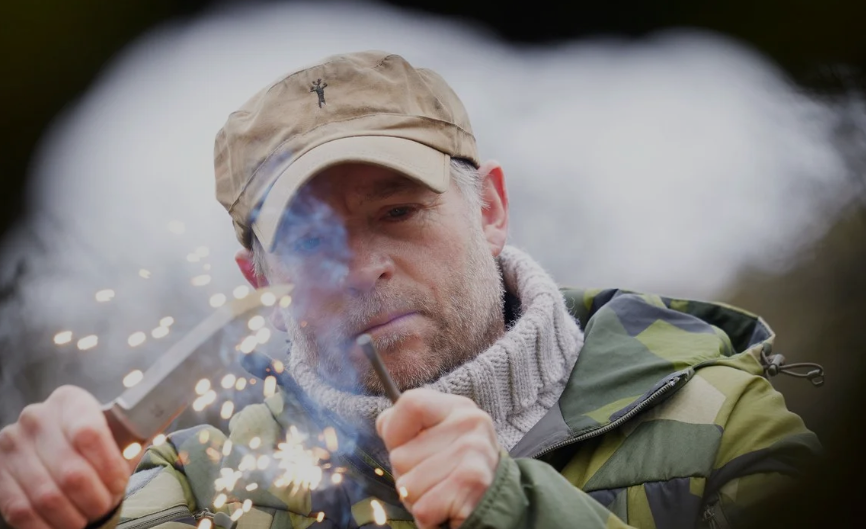
We were also incredibly lucky to have Andrew Thomas Price keeping the day on track as our MC.
Andrew brought a wonderfully different perspective to the launch. As a contestant on Season 13 of the television programme Alone, as well as an experienced outdoor adventurer and bushcraft specialist, he knows what it really means to depend on nature, not simply to visit it.
His knowledge of survival skills, living outdoors and working with the natural environment brought an interesting extra dimension to a day focused on nature recovery and our relationship with the natural world.
There was something rather fitting about having someone who has spent time pushing himself to survive in the wild helping to guide a day celebrating all the people who are working to ensure that our wild places, habitats and species have a future.
And Andrew was a brilliant MC, knowledgeable, relaxed and able to bring his own experience of the outdoors into the conversations throughout the day.
It was another reminder that our relationship with nature takes many different forms. For some of us it is conservation, for others volunteering, science, wellbeing or simply discovering the wildlife on our doorstep.
And for Andrew, it has quite literally included learning how to survive within it!
Andrew Thomas Price is a highly respected extreme survival specialist and television professional with decades of practical experience operating in challenging wilderness environments. Andrew is best known as a long-standing presenter on ITV Cymru Wales’ BAFTA-nominated series Coast & Country
And a little confession…
And then there was the small matter of me speaking on the main stage! I will confess that standing up in front of everyone and talking about our Wellbeing Hub was considerably more terrifying than wandering through the woodland in the dark looking for bats, owls or nightjars!
There may have been a small requirement for smelling salts afterwards… But I survived and I was incredibly proud to have the opportunity to tell people about what our volunteers have created at Coed y Werin.
From one celebration to the next
The wonderful thing about a day like this is that it doesn’t end when everyone packs away their stands. The conversations continue. The connections continue. And the work continues.
So we are delighted that next week we’ll be taking Caerphilly Woodlands Trust on the road again, this time to Parc Cwm Darren for the Caerphilly Nature Fair.
We’ll be back with our stand, our wonderful volunteers, our woodland crafts, our stories and, of course, plenty to talk about when it comes to connecting people with nature.
Thankfully, there won’t be a main-stage talk this time, so I can leave the smelling salts at home!
A huge thank you to everyone who made the Caerphilly Nature Recovery Action Plan launch such a success, to all the speakers who shared their knowledge, to the organisers and volunteers who brought it together, and to everyone who stopped by our stand.
Most of all, thank you to the Caerphilly Nature Partnership for creating a space where so many different people and organisations can come together. Because nature recovery isn’t something any one organisation can achieve alone. It is something we do together — one woodland, one meadow, one species, one community and one person at a time.
And Caerphilly Woodlands Trust is very proud to be playing our part in making wellbeing accessible to all
Wellbeing – Seven Years. That’s the Gap We’re Trying to Close.
A boy born in Monmouthshire today can expect nearly 66 years of good health. A boy born a few miles away in Caerphilly can expect just under 60. For girls, the gap is even wider, almost eight years of healthy life, gone, simply because of a postcode.
That is not a statistic. That is somebody’s father not seeing their grandchildren grow up in good health. It’s somebody’s mother managing a chronic illness a decade before she should have to. It is the single clearest reason our woodland and wellbeing hub exists, and why we believe it deserves your support.
The inequality is not abstract. It’s on our doorstep.
Two of the communities that sit closest to our woodland — Lansbury Park and Graig y Rhacca — are not marginally deprived. They are among the most deprived in the whole of Wales.
- In the newest Welsh Index of Multiple Deprivation (WIMD 2025, published November 2025), Lansbury Park (St James 3) is ranked the 2nd most deprived small area in the whole of Wales, out of 1,917 areas assessed.
- Lansbury Park is one of only 22 areas in the whole of Wales classed as being in “deep-rooted deprivation” — meaning it has remained in the top 50 most deprived areas in every WIMD assessment for the past 20 years. Caerphilly county borough has 4 of these 22 areas — more than almost any other local authority in Wales.
- Graig y Rhacca, sitting within the Bedwas, Trethomas & Machen ward, has also consistently ranked in the most deprived 10% of areas in Wales for overall deprivation, income, employment, health and education, according to the Gwent Public Services Board’s own local well-being assessment.
- Caerphilly county borough was ranked 7th out of 22 Welsh local authorities for the proportion of its wards falling in the most deprived 10% nationally.
This is precisely the geography our woodland sits in. We are not building a wellbeing hub in a leafy suburb hoping it gets used. We are building it exactly where the evidence says it is needed most.
Why deprivation and health are the same story
The Office for National Statistics doesn’t leave much room for doubt here. Comparing the most and least deprived areas of Wales (2022–2024 data):
| Most deprived areas | Least deprived areas | Gap | |
|---|---|---|---|
| Male healthy life expectancy | 49.7 years | 67.8 years | 18.1 years |
| Female healthy life expectancy | 47.3 years | 66.3 years | 19.0 years |
Read that again. A man in the most deprived parts of Wales can expect to live barely 49.7 years in good health, less time than it takes many people to build a career, raise a family and see them settled. Someone in the least deprived areas gets almost two extra decades of healthy life.
This isn’t inevitable. It’s driven by the conditions people live in — income, employment, education, housing, and crucially, access to green space, nature and community. These are exactly the levers a woodland wellbeing hub can pull.
Green space isn’t a nice-to-have. It’s a health intervention.
There is now a substantial and specifically Welsh evidence base for this. Researchers linking the health records of over two million people in Wales to data on their local environment (the Green and Blue Spaces e-cohort, run by Swansea University and University of Liverpool via the SAIL Databank) found that ambient greenness and access to local green space were associated with better long-term mental health across a ten-year study of 2.3 million adults.
The mechanisms are well understood: time in woodland and green space reduces stress, encourages physical activity, increases social contact, and supports psychological recovery. And there’s a particularly important finding for places like Lansbury Park and Graig y Rhacca: a UK systematic review found that the mental health benefits of green space tend to be strongest in socioeconomically disadvantaged communities, the effect is not evenly spread, it is concentrated exactly where the need is greatest.
In other words: a woodland wellbeing hub in one of Wales’s most deprived communities isn’t just “also” doing good work on health. It’s doing the most effective possible version of that work, in the place where it will have the biggest measurable impact.
The public good goes further than wellbeing
Our woodland isn’t only a health intervention. It’s doing several jobs at once, all of which matter to funders working across different priorities:
Carbon capture. UK Forest Research data shows that established broadleaf woodland typically sequesters somewhere in the region of 2.5–3.9 tonnes of CO2 per hectare per year, with native broadleaf projects capturing in the order of 250–500 tonnes of CO2 per hectare over a 30–100 year period. Every hectare of our woodland that is protected, managed and expanded is doing quiet, permanent work against climate change — while also delivering the health and social outcomes above. Few interventions can genuinely claim to serve both agendas at once.
Renewable energy and environmental infrastructure. Woodlands like ours also support the wider renewable and low-carbon energy picture — from sustainable woodfuel and biomass potential to reducing flood risk, improving air quality, and supporting the biodiversity that underpins resilient local ecosystems. This is public infrastructure that would cost significant public money to replace if lost.
Community and social infrastructure. A wellbeing hub in this location supports exactly the kind of local, place-based activity that policy makers keep saying is needed to close health inequality gaps — without needing people to travel, without needing specialist referral, and without the stigma that can attach to clinical services.
And our volunteers do it for nothing
None of this work is currently funded in a way that reflects its value. We deliver health impact, carbon capture, environmental protection and community wellbeing, for a community facing some of the steepest health inequalities in Wales, as a volunteer-driven, largely unfunded effort.
That is not sustainable, and it shouldn’t have to be.
The case for investment is not a hopeful one. It is written into the official statistics: an 18–19 year healthy life expectancy gap between the most and least deprived parts of Wales, two of the most deprived communities in the entire country sitting right beside us, and a growing, specifically Welsh evidence base showing that green space interventions work best exactly where we are.
We’re not asking funders to take a chance on an idea. We’re asking them to back something the evidence already says is one of the most effective possible interventions, in one of the places that needs it most.
Sources
- Office for National Statistics, Healthy Life Expectancy at Birth, 2021–2023 (Caerphilly/Monmouthshire) and 2022–2024 (deprivation deciles, Wales)
- Welsh Government, Welsh Index of Multiple Deprivation (WIMD) 2025, published 27 November 2025 — gov.wales
- Gwent Public Services Board, Caerphilly Basin Local Well-being Assessment
- Caerphilly Observer, coverage of WIMD 2025 results, November 2025
- Geary RS, et al., “Ambient greenness, access to local green spaces, and subsequent mental health: a 10-year longitudinal dynamic panel study of 2.3 million adults in Wales,” Lancet Planetary Health, 2023
- ScienceDirect, “Impact of residential green spaces on health inequalities in the UK: A systematic review and exploratory meta-analysis,” 2026
- Forest Research, Forestry Statistics 2025 and Establishing New Woodland guidance, UK Government
To see our Celebration of Nature, People and Partnerships presentation
click the link below

